01
Web Applications
Custom portals, dashboards, SaaS products, operational software and database-backed applications built around the way your business works.
Legion Algo Labs builds practical web applications, mobile apps, AI integrations, automation, SaaS products, internal tools and business systems for founders and businesses in New Zealand and worldwide.
Start with a business problem, a product idea or an existing system that needs to work better. You do not need a finished technical specification.
What we build
Build a new product, connect an existing operation or recover a project that has stopped moving. The technology follows the business case—not the other way around.
Custom portals, dashboards, SaaS products, operational software and database-backed applications built around the way your business works.
iOS and Android applications with authentication, notifications, subscriptions, payments, APIs and backend infrastructure where required.
Practical assistants, document processing, workflow intelligence, data analysis and AI-enabled product functionality with a real operating purpose.
Replace repetitive administration, disconnected spreadsheets, email handoffs and duplicate data entry with a clearer connected workflow.
View related serviceTake a validated concept from requirements and architecture through prototype, development, deployment and early production learning.
Customer portals, internal dashboards, integrations, reporting systems and specialised operational software that fit your process.
View related serviceAudit, stabilise, modernise or complete a stalled product. Start by understanding the code, risks and practical route to a maintainable release.
Recognise the problem
The strongest opportunities are often visible in the workarounds people have learned to tolerate. A short discovery conversation can establish whether custom software is justified—or whether a simpler change is enough.
Built by Legion
Legion HQ
Proof of capability
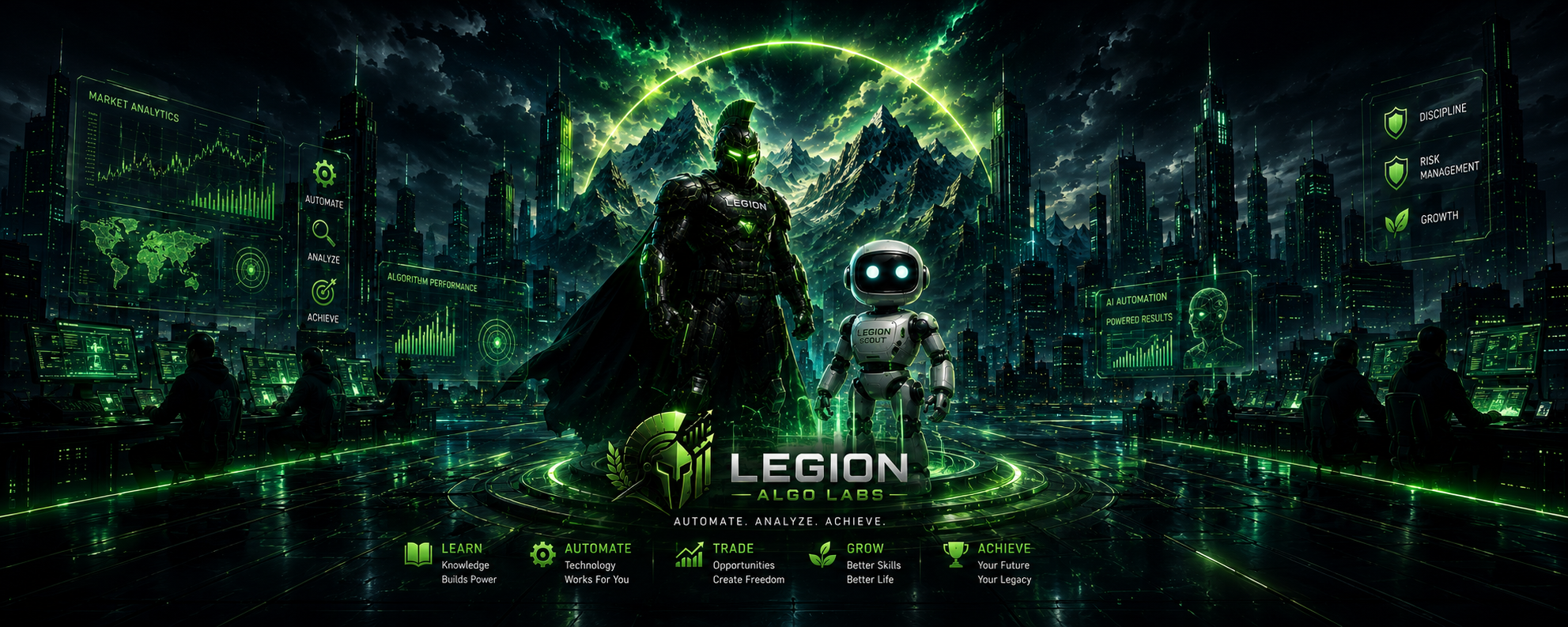
Legion HQ is Legion Algo Labs’ own cross-platform product. It brings structured education, analysis, risk tools, journaling and account-based access together across web, iOS and Android—demonstrating product architecture beyond a brochure website or isolated prototype.
How we work
The exact shape changes with each engagement, but the decision sequence stays clear.
Understand the business problem, users, current workflow, technical constraints and commercial goal.
Define the smallest useful version, architecture, responsibilities, milestones, assumptions and pricing approach.
Design and develop the product in reviewable stages using technology appropriate to the problem.
Check functionality, usability, integrations, performance and the workflows that matter before release.
Deploy to production infrastructure, the web, App Store or Google Play as the agreed scope requires.
Support, monitor and iterate after launch where an ongoing engagement is useful and agreed.
Why Legion
The aim is a direct working relationship, practical decisions and a product that can be understood and maintained after launch.
Work closely with the person responsible for understanding the problem and leading technical delivery.
The work considers users, workflow, deployment, data, security, payments, notifications and maintenance—not only the interface.
Web, mobile, AI, APIs, databases, automation and cloud infrastructure can be combined into one coherent product.
Begin with discovery or a focused system, then expand when the first stage has demonstrated value.
Project investment
Focused integrations or automation work may begin in the low thousands of New Zealand dollars. Full applications and production platforms require significantly larger budgets. Complex work may begin with paid discovery and scoping before a build is quoted.
Remote collaboration uses video calls, clear written decisions and staged reviews. That keeps work visible across time zones while retaining direct access to the person leading delivery.
Questions before discovery
The useful answer usually depends on the business, users and existing systems. These are the starting points.
Legion Algo Labs builds web applications, mobile apps, SaaS products, MVPs, customer portals, internal systems, dashboards, integrations, workflow automation and practical AI-enabled features.
Yes. A project can include a web application, an iOS and Android application, or a coordinated cross-platform product with shared accounts, data and backend services where that architecture is appropriate.
Potentially. The first step is usually a technical audit covering the current code, infrastructure, access, documentation, security risks and remaining scope. That review determines whether repair, staged modernisation or a rebuild is the sensible route.
Yes. Engagements can support a founder validating a focused MVP, a small business replacing manual work, or an established team needing an integration, internal system or additional product capability.
Yes. Legion Algo Labs is based in New Zealand and can work remotely with founders, businesses and agencies worldwide using video calls, written decisions and staged project reviews.
Yes, where AI has a clear job to do. That may include assistants, document processing, classification, structured drafting, data analysis or workflow support. Data handling, reliability, human review and operating cost are considered before implementation.
Yes. MVP work starts by narrowing the concept to the smallest version that can test the important assumption or deliver useful value. Scope, architecture and release stages are agreed before development begins.
Every project is scoped individually. Focused integrations or automation work may begin in the low thousands of New Zealand dollars, while full applications and production platforms require significantly larger budgets. Complex projects may begin with a paid discovery and scoping stage before a build is quoted.
It depends on scope, integrations, product maturity and review availability. A focused piece of work may take weeks, while a full application commonly requires multiple stages over several months. A realistic schedule is provided after discovery rather than promised before the requirements are understood.
Ongoing support, monitoring, maintenance and further development can be included where agreed. The appropriate arrangement depends on the product, infrastructure and response expectations.
Ownership and licensing are set out in the written project agreement. Bespoke deliverables can be assigned to the client after agreed payments are complete, while pre-existing tools, reusable components and third-party software remain subject to their stated licences.
Yes. These are established parts of modern product delivery and are included when the project requires them. Provider choice, compliance obligations, recurring costs and failure handling are considered during scope and architecture.
Bring the idea, the bottleneck or the stalled project. We will start by understanding the problem and deciding whether there is a sensible build path.
The discovery CTA sends a meeting request. A time is confirmed after the project summary is reviewed.